+34 620 10 75 37info@nanbiosis.com

News U29

NANBIOSIS researchers featured in the 15th Edition of Spanish Researchers Ranking

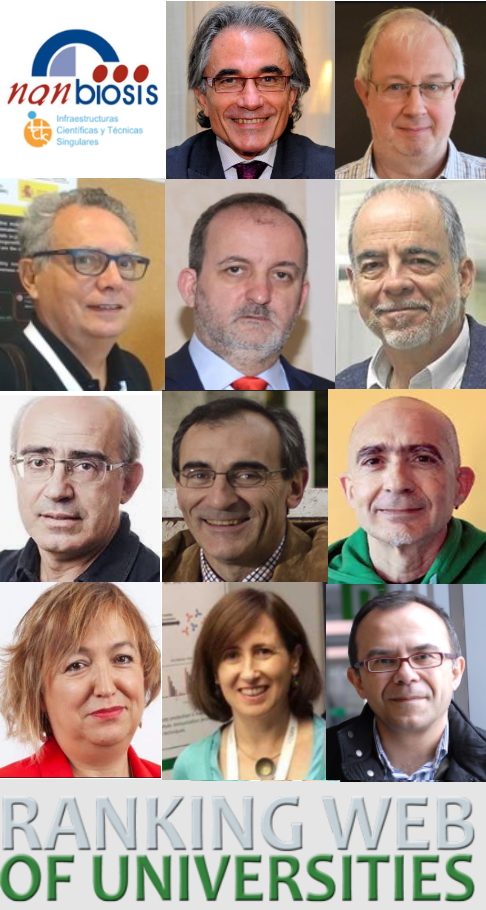
The 15th edition of the Webometrics Ranking of World Universities has been published, ranking researchers in Spain as well as Spaniards doing research abroad. A total of 11 Directors of NANBIOSIS units appear on the most recent list, featured on the top 2000. The list is ordered by the h-index, a metric that calculates research impact based on a correlation of papers published and number of citations, and then by number of citations. The result is a list of whose’s publications have had more impact online.

NANBIOSIS researchers featured are Fernando Albericio (#207), scientific director of U3 Synthesis of Peptides Unit, Ramón Martínez Máñez (#342) U26 NMR: Biomedical Applications II, Jaume Veciana (#459) U6 Biomaterial Processing and Nanostructuring Unit, José Luis Pedraz (#906) U10 Drug Formulation unit, Jesús Santamaría (#912) U9 Synthesis of Nanoparticles Unit, Ramón Eritja (#1022) U29 Oligonucleotide Synthesis Platform (OSP), Pablo Laguna (#1153) U27 High Performance Computing, Antoni Villaverde (#1249) U1 Protein Production Platform (PPP), Laura Lechuga (#1511) U4 Biodeposition and Biodetection Unit M.Pilar Marco (#1517), U2 Custom Antibody Service (CAbS), and Josep Samitier (#1836) U7 Nanotechnology Unit.

This list reflects on the impact online publication can have as a tool to share knowledge. 

For further information: here
Read More

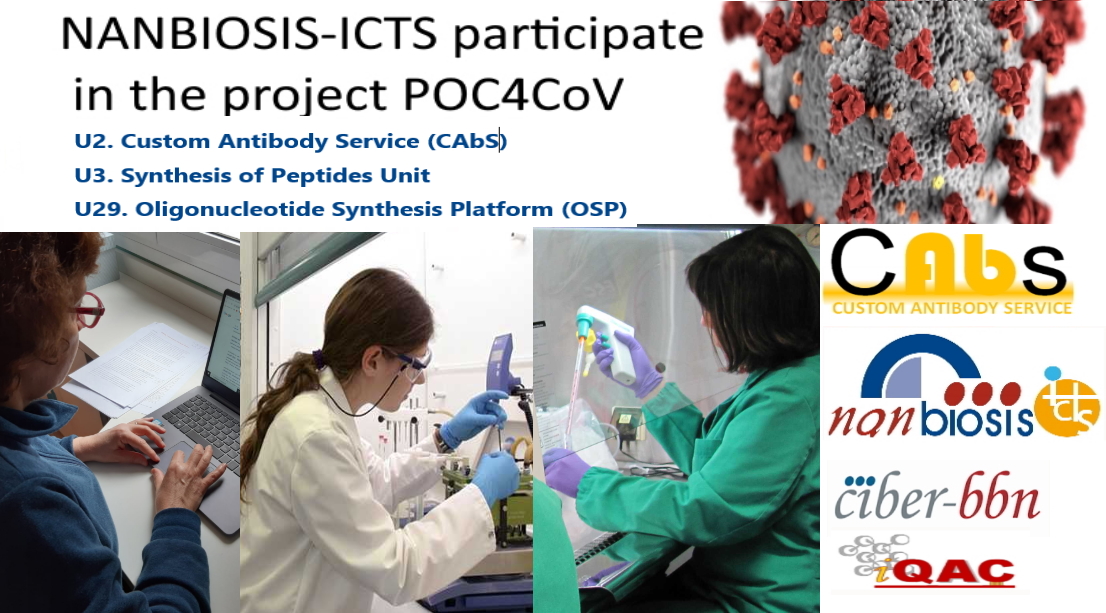
NANBIOSIS U2, U3 & U29 participate in the POC4CoV project to develop diagnostic technologies for SARS-COV-2

The Spanish Higher Council for Scientific Research (CSIC) will finance the project Point-of-care tests for the rapid detection of SARS-CoV-2 (POC4CoV), whose objective is to have effective diagnostic technologies for Covid-19. The Institute of Microelectronics of Barcelona (IMB-CNM-CSIC), the Institute of Advanced Chemistry of Catalonia (IQAC-CSIC) and the Institute of Materials Science of Aragon (ICMA) participate in it.

The POC4CoV project aims to develop Point-of-Care (POC) devices for the in vitro diagnosis of SARS-COV-2 infection quickly and reliably, thanks to the use of multiplexed systems and the use of particular biomolecular probes. To do this, POC technological platforms will be used in combination with specific capture biomolecules and nanobiotechnological probes (enzyme bioconjugates and biofunctional plasmonic and magnetic nanoparticles), which will allow the simultaneous detection of different biomarkers (viral RNA and antigens, IgM and IgG) related to Covid-19 disease. The biomolecular complexes will be collected at specific points on the devices where the electrochemical or optical signals will be recorded.

The developed POC platforms will undergo analytical and clinical validation in a clinical setting.

Three units of NANBIOSIS (form CIBER-BBN and IQAC-CSIC) will will take an active participation in the project.

NANBIOSIS Unit 2 Custom Antibody Service (CAbS), will produce antibodies against the Spike protein and other virus proteins, trying to maximize the recognition of those epitopes that differentiate SARS-CoV-2 from other Coronaviruses

NANBIOSIS Unit 3 Synthesis of Peptides Unit will synthesize peptidic sequences that will allow to identify towards which epitopes the immune response is directed, which will allow to develop more specific diagnostic methods.

NANBIOSIS Unit 29 Oligonucleotide Synthesis Platform (OSP) has designed probes with oligonucleotide sequences that will allow the capture of viral RNA through the formation of high affinity triplex complexes

Read More

Ethylcellulose nanoparticles as new “in vitro” tool for cell transfection

Researchers of NANBIOSIS U12 Nanostructured liquid characterization unit and U29 Oligonucleotide Synthesis Platform (OSP) of CIBER-BBN at IQAC-CSIC have obtained successfully ethylcellulose nanoparticles with positive zeta potential formed from nano-emulsion complexation with an antisense oligonucleotide which result very promising complexes for “in vitro” cell transfection.

A new non-viral gene delivery vector has been developed, based on ethylcellulose, an easily available and low cost carbohydrate polymer, “generally recognized as safe” by the FDA. Although ethylcellulose is nonionic, positively charged nanoparticle dispersions have been obtained using nano-emulsion templates in cationic:non-ionic surfactant-based systems. The nanoparticles have been successfully complexed with negatively charged phosphorothioate antisense oligonucleotides. These short nucleic acid chains are advantageous as they show improved cell penetration ability and higher resistance to degradation by nucleases. The nanoparticle:oligonucleotide complexes obtained show suitable transfection efficiency and are promising for “in vitro” gene transfection purposes.

This research has been developed through the close collaboration between the Colloidal and Interfacial Chemistry group led by Dr. Carlos Rodríguez Abreu, and the Nucleic Acids Chemistry group led by Dr. Ramon Eritja as well as the NANBIOSIS U12 and U29 Units. Both groups belong to the Institute of Advanced Chemistry of Catalonia (IQAC-CSIC) and the CIBER-BBN.

Article of reference: Leitner, S.; Grijalvo, S.; Solans, C.; Eritja, R.; Garcia-Celma, M. J.; Caldero, G., Ethylcellulose nanoparticles as a new “in vitro” transfection tool for antisense oligonucleotide delivery CARBOHYDRATE POLYMERS 229,1, 115451, 2020; DOI: 10.1016/j.carbpol.2019.115451

Read More

Cationic nioplexes in supramolecular hydrogels as hybrid materials to deliver nucleic acids

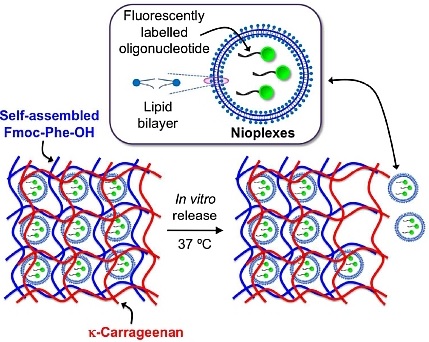
Jose Luis Pedraz, Scientific Director of Unit 10 of NANBIOSIS Drug Formulation unit and Ramon Eritja Scientific Director of Unit U29 of NANBIOSIS Oligonucleotide Synthesis Platform (OSP) (CIBER-BBN) have participated in the entrapment of cationic nioplexes in supramolecular hydrogels and the use of these materials for transfecting cells.

This work is focused on entrapping cationic nioplexes within supramolecular hydrogels based on N-protected phenylalanine. To modulate the supramolecular hydrogel diffusion properties, hydrogels were easily tuned with ĸ-carrageenan (≤ 1%). These materials were fully characterized using rheology. The niosomal liberation in solution through hydrogels was monitored by fluorescence and this release was controlled by diffusion mechanisms. The lack of toxicity of these materials allowed these materials to be used in cell culture. Preliminary transfection results confirmed the suitability of entrapping niosomal formulations in supramolecular hydrogels and the potential opening up of alternative strategies in therapy.

This study was published in RSC Advances:

S. Grijalvo, G. Puras, J. Zárate, R. Pons, J.L. Pedraz, R. Eritja, D. Díaz. “Nioplexes encapsulated in supramolecular hybrid biohydrogels as versatile delivery platforms for nucleic acids” 2016, 6, 39688-39699. DOI: 10.1039/C6RA01005A

Nanbiosis_U10_Cationic nioplexes in supramolecular hydrogels as hybrid materials to deliver nucleic acids
Read More